
Organizations across the United States are accelerating digital initiatives, but gauging their effectiveness requires more than technology adoption, it requires structured assessment.
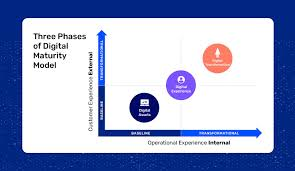
Many leaders use the digital transformation maturity model to evaluate readiness, capability, and progress across strategic and operational dimensions.
According to market research, 89% of organizations globally have implemented or plan to adopt a digital-first strategy, indicating widespread recognition of transformation as a growth imperative and the need for maturity frameworks that measure depth and impact rather than individual technology rollouts.
Defining What the Digital Transformation Maturity Model Measures
Before assessing transformation, it’s important to understand what a maturity model evaluates and why it’s more than a checklist of tools.
To grasp the purpose and scope of maturity assessment within transformation initiatives, organizations examine the following dimensions:
- Progress through distinct maturity stages – A maturity model structures transformation into clear levels, such as emerging, developing, defined, monitored, and optimized. These stages help organizations understand where they stand relative to their long-term digital goals.
- Capability versus technology adoption – Rather than focusing solely on tools, maturity models assess how well technology supports business outcomes, cultural readiness, and process execution.
- Alignment with strategic objectives – A maturity assessment ensures that digital initiatives map directly to defined business objectives, such as cost efficiency, customer experience enhancement, or innovation acceleration.
- Balanced evaluation of people, process, and technology – Mature organizations measure transformation across resources, workflows, and systems not just software deployment , offering a holistic performance view.
- Benchmarking against best practices and peers
Comparing maturity with industry benchmarks highlights strengths and gaps, enabling informed planning rather than isolated self-assessment.
Understanding what a maturity model measures helps organizations move beyond tactical execution toward strategic, capability-centered transformation.
Evaluating Leadership, Vision, and Strategic Alignment
Digital maturity starts at the top. Without strong leadership engagement and clear strategic direction, transformation efforts often lack focus, accountability, or measurable outcomes.
To assess strategic readiness and governance maturity, organizations explore the following criteria:
- Executive sponsorship and commitment – Mature organizations demonstrate visible leadership engagement, ensuring that digital transformation is a strategic priority rather than a siloed project or department initiative.
- Clarity of digital vision and roadmap – A clear vision coupled with actionable roadmaps ensures teams understand strategic priorities, timelines, and expected benefits, reducing misalignment across functions.
- Governance structures and oversight mechanisms – Formal governance ensures transformation initiatives are reviewed, resourced, and measured consistently, reducing duplication and promoting transparency.
- Strategic resource allocation – Assessing where teams invest budget, people, and time shows whether transformation aligns with business goals rather than tactical “firefighting.”
- Risk and compliance integration – Mature strategies integrate cybersecurity, data privacy, and regulatory considerations into planning, reinforcing trust and operational resilience.
Strategic assessment of leadership and governance readiness ensures transformation remains focused, accountable, and aligned with broader organizational goals.
Assessing Process Integration and Operational Transformation
Transformation maturity also shows up in how well digital capabilities are embedded into core business processes and not just isolated digital initiatives.
To evaluate operational integration and process maturity, organizations consider the following aspects:
- Process standardization and mapping – Mature organizations have well-defined processes documented and mapped, reducing variability and enabling consistent execution across departments.
- Integration of digital workflows – Digital maturity reflects how seamlessly workflows connect across functions, ensuring data flows freely and decisions are based on real-time insight.
- Use of intelligent automation and workflows – When automation supports routine work and intelligent routing, organizations reduce manual effort while improving speed and accuracy.
- Data-driven operational decision-making – Mature entities use real-time operational data for decision-making rather than relying on historical or static reports.
- Continuous refinement of processes – Mature environments invest in iterative improvement cycles where performance metrics guide ongoing optimization rather than one-time redesigns.
Evaluating process integration reveals whether digital transformation is embedded into how work gets done, leading to operational efficiency and responsiveness.
Measuring Technology Stack Readiness and Data Capabilities
A mature transformation isn’t determined by how many tools are implemented but by how well technology and data systems support business agility and insight.
To assess technology and data maturity, organizations examine these elements:
- Modern, scalable platform architecture – Mature organizations use flexible, cloud-ready platforms that integrate easily with new capabilities and scale with evolving needs.
- Quality of data governance and access controls – Strong data governance ensures trusted, consistent data that fuels analytics, compliance, and secure decision-making across the enterprise.
- Advanced analytics and insights generation – Organizations with higher maturity use predictive and prescriptive analytics rather than basic reporting to guide strategy and operational decisions.
- Integration between systems and data sources – Mature digital environments enable seamless data exchange across CRM, ERP, operations, and customer experience platforms, eliminating silos and duplication.
- Technical support and adaptability – Readiness includes the organization’s ability to absorb updates, integrate new solutions, and pivot without disrupting ongoing operations.
Evaluating technology and data capabilities helps determine whether digital transformation becomes a strategic enabler of intelligence and adaptability, not just a collection of disparate tools.
Workforce & Culture: Enabling Human Readiness for Transformation
Technology alone doesn’t drive maturity, people do. Organizational culture, skills, and internal alignment are central to transformation maturity.
To measure workforce and cultural readiness, organizations assess the following:
- Digital literacy and skill development – Mature organizations invest in ongoing learning to ensure employees can use digital tools effectively and contribute to innovation.
- Employee engagement with digital change – Engagement levels indicate how workforce members perceive and support transformation rather than resist it due to uncertainty or lack of clarity.
- Collaboration and cross-functional teams – Collaboration across functions supported by shared goals and communication channels reflects higher maturity and fewer silos.
- Change management capabilities – Structured change management processes address resistance, support transition, and ensure adoption rather than superficial compliance.
- Alignment of incentives and performance metrics – Linking performance indicators to digital outcomes reinforces desired behaviors and sustains transformation momentum.
Workforce and culture assessment ensures the human side of digital transformation is aligned with strategic goals and operational expectations, reducing resistance and accelerating adoption.
Conclusion
Assessing digital transformation through a structured maturity model provides a roadmap for sustainable progress rather than episodic technology deployment.
By evaluating leadership alignment, strategic intent, operational integration, technology readiness, and workforce engagement, organizations gain a holistic understanding of how effectively they are becoming digital enterprises.
Regular maturity assessment helps teams prioritize initiatives that drive value rather than activity that produces little impact. In practice, organisations like Zoho and others demonstrate how integrated platforms can support maturity progression across multiple dimensions, enabling firms to evolve from early experimentation to strategic optimization.
Businesses that measure and refine digital maturity are better positioned to innovate, respond to disruption, and sustain growth in an increasingly digital landscape.