
Machine learning has become a key part of modern technology. From predicting customer behavior to powering voice assistants, it is now used in almost every industry. Python is the most popular programming language for this work because it offers a huge range of tools.
In 2025, new updates and improvements in Python libraries have made building, training, and deploying models faster and more accurate. Whether you are just starting or already working in this field, knowing the right tools can save time and improve results.
This guide shares the Top 10 Python Libraries for Machine Learning You Must Know, with their main uses and the latest updates that make them valuable today.
Table of Contents
Why Python Dominates in Machine Learning
Python is the first choice for machine learning because it is easy to read, write, and understand. Its simple syntax allows developers to focus on solving problems instead of struggling with complex code structures.
It also has one of the largest collections of libraries for data processing, modeling, and visualization. These libraries save time by providing ready-to-use functions for tasks like cleaning data, building models, and creating graphs.
Another reason is Python’s strong community support. Thousands of developers share tutorials, code examples, and updates, which makes learning and troubleshooting easier. In 2025, this support continues to grow with more resources and frequent library updates.
How We Chose These Libraries
The libraries in this list are not random picks. Each one was chosen after looking at its popularity, active development, and real-world performance. We focused on tools that are widely used in both research and industry. Libraries with regular updates in 2025 were given priority, as this ensures better features, faster processing, and stronger security.
Ease of use was another key factor. A good machine learning library should save time without limiting what you can do. We also included a mix of beginner-friendly and advanced tools so this list can help all types of users.
Top 10 Python Libraries for Machine Learning
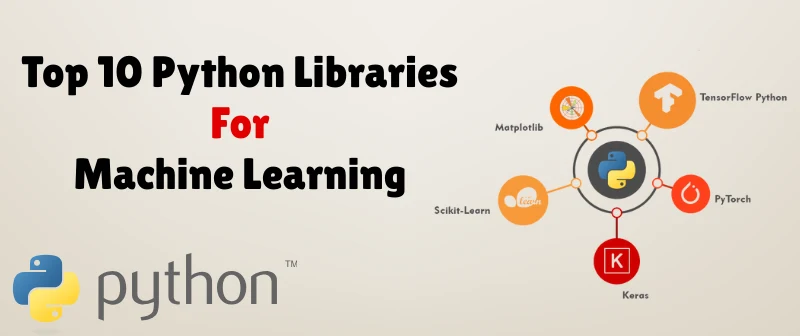
Here is the list of 10 top Python libraries for machine learning in 2025:
- TensorFlow
- Scikit-learn
- PyTorch
- Keras
- Pandas
- NumPy
- Matplotlib
- Seaborn
- XGBoost
- LightGBM
Let’s learn about each of them in detail.
1. TensorFlow
TensorFlow is one of the most powerful tools for building and running machine learning models. It was created by Google and is trusted by companies worldwide for deep learning and AI projects.
Key Features
- Supports building models from simple to highly complex.
- Works on CPUs, GPUs, and mobile devices.
- Includes tools for training, testing, and deploying models.
Best For: Deep learning projects, image recognition, natural language processing, and large-scale production systems.
Latest Update: TensorFlow 2.16 offers faster training speeds, improved multi-GPU support, and better integration with cloud platforms. It also includes new pre-trained models to help you start projects quickly.
2. Scikit-learn
Scikit-learn is one of the most popular libraries for traditional machine learning tasks. It is simple to use and works well for both beginners and experienced developers.
Key Features
- Wide range of algorithms for classification, regression, and clustering.
- Tools for data preprocessing and feature selection.
- Built-in model evaluation methods.
Best For: Small to medium datasets, academic projects, and quick experiments.
Latest Update: The latest version includes faster model training, better compatibility with Python 3.13, and improved tools for handling missing data. It also adds new options for automated hyperparameter tuning.
3. PyTorch
PyTorch is a flexible library favored by researchers and developers who want to build and test machine learning models quickly. It is known for its dynamic computation and ease of use.
Key Features
- Dynamic computation graph for flexible model design.
- Strong support for GPU acceleration.
- Easy debugging and clear syntax.
Best For: Research projects, AI experiments, and building prototypes.
Latest Update: PyTorch 2.1 improves model speed, adds better support for distributed training, and introduces tools for easier deployment on cloud platforms.
4. Keras
Keras is a user-friendly library designed to make building deep learning models simple and fast. It acts as a high-level interface, mostly running on top of TensorFlow.
Key Features
- Easy to learn and use with clear, simple code.
- Supports building complex neural networks quickly.
- Integrates tightly with TensorFlow for better performance.
Best For: Beginners and developers who want to create deep learning models without writing complex code.
Latest Update: Keras now offers more pre-built layers and new tools for model explainability, helping users understand how their models make decisions.
5. Pandas
Pandas is a must-have library for data manipulation and analysis. It helps prepare data before using it in machine learning models.
Key Features
- Provides easy-to-use data structures like DataFrames.
- Handles missing data and merges datasets smoothly.
- Supports filtering, grouping, and reshaping data.
Best For: Data cleaning, exploration, and preprocessing tasks.
Latest Update: The latest version improves performance for large datasets and adds new functions for time series data handling.
6. NumPy
NumPy is the foundation for numerical computing in Python. It provides fast and efficient tools to work with arrays and matrices.
Key Features
- Supports multi-dimensional arrays.
- Offers mathematical functions for linear algebra and statistics.
- Works well with other machine learning libraries.
Best For: Handling large numerical datasets and performing core calculations in machine learning.
Latest Update: NumPy 1.27 improves speed for large array operations and adds better support for parallel computing.
7. Matplotlib
Matplotlib is a popular library for creating graphs and charts. It helps visualize data and model results clearly.
Key Features
- Supports many types of plots like line, bar, and scatter plots.
- Highly customizable graphs and layouts.
- Works well with other Python data tools.
Best For: Visualizing data trends, model performance, and comparison of results.
Latest Update: Matplotlib 3.8 introduces smoother animations and better support for interactive plotting in web apps.
8. Seaborn
Seaborn builds on Matplotlib to create attractive and easy-to-understand statistical graphics. It is great for exploring data patterns.
Key Features
- Simple functions to create heatmaps, pair plots, and violin plots.
- Works smoothly with Pandas DataFrames.
- Automatically handles color themes and styles.
Best For: Exploratory data analysis and visualizing statistical relationships.
Latest Update: Seaborn 0.13 adds new plot types and improved support for large datasets, making visuals clearer and faster to create.
9. XGBoost
XGBoost is a powerful library for gradient boosting. It is known for speed and accuracy in many machine learning competitions.
Key Features
- Fast training and prediction.
- Handles missing values automatically.
- Supports parallel and distributed computing.
Best For: Structured data problems, ranking tasks, and winning Kaggle competitions.
Latest Update: XGBoost 1.7 improves training speed and adds better support for GPU acceleration. It also includes new tools for model interpretation.
10. LightGBM
LightGBM is Microsoft’s gradient boosting framework. It focuses on high performance and low memory use.
Key Features
- Faster training on large datasets.
- Uses histogram-based algorithms to reduce memory consumption.
- Supports categorical features directly.
Best For: Large datasets, high-dimensional data, and production systems.
Latest Update: LightGBM 4.0 adds improved accuracy, faster training, and better integration with cloud platforms.
Honorable Mentions
Besides the top 10, some other Python libraries are also useful in machine learning:
- CatBoost: A gradient boosting library that handles categorical data well without needing extra preprocessing. It is easy to use and performs well on many datasets.
- Statsmodels: Focuses on statistical modeling and tests. It helps in understanding relationships in data and building classical statistical models.
- SpaCy: A fast and efficient library for natural language processing. It supports tasks like tokenization, named entity recognition, and part-of-speech tagging.
These libraries can complement your machine learning projects depending on your needs.
Choosing the Right Library for Your Project
Not every library fits every project. You should pick one based on your specific needs.
- If you work with large datasets or need fast training, libraries like LightGBM or XGBoost are good choices.
- For deep learning and neural networks, TensorFlow, PyTorch, or Keras work best.
- Beginners should start with Scikit-learn or Keras because they are easy to learn.
- If your project involves a lot of data cleaning or preparation, use Pandas and NumPy.
- For visualizing data, Matplotlib and Seaborn make it simple to understand results.
Think about your project size, your skill level, and the model complexity before choosing a library. This will help you save time and get better results.
Conclusion
In this guide, we have covered the Top 10 Python Libraries for Machine Learning You Must Know in 2025. These libraries offer tools for every step of machine learning — from data handling and visualization to building complex models.
Choosing the right library depends on your project needs and skill level. Beginners can start with Scikit-learn or Keras, while advanced users may prefer TensorFlow or LightGBM for faster and larger projects.
Stay updated with these libraries to keep your machine learning skills sharp and effective in 2025 and beyond. If you found this guide helpful, start exploring these libraries today and build your next machine learning project with confidence!
FAQs
Here are some of the most commonly asked questions related to Python libraries:
1. What is the best Python library for beginners in machine learning?
Scikit-learn and Keras are the best for beginners. They have simple code and clear documentation. These libraries help you learn quickly without too much complexity. You can build basic to advanced models easily.
2. Can I use more than one machine learning library in a project?
Yes, you can use multiple libraries together. For example, use Pandas for data cleaning and TensorFlow for building models. Combining libraries helps you use the best tools for each task. Python makes it easy to mix libraries.
3. Which library is fastest for training large datasets?
LightGBM and XGBoost are very fast with large data. They use smart algorithms to train quickly. Both support parallel processing to use your computer power well. They also handle missing data and large features efficiently.
4. Is TensorFlow better than PyTorch?
Both have strong points. TensorFlow works well for production and deployment. PyTorch is easier for research and quick experiments. Your choice depends on your project needs and personal preference.
5. Do these libraries work on all operating systems?
Yes, most libraries support Windows, macOS, and Linux. They also work on cloud platforms and some support mobile devices. This makes it easy to run your projects anywhere.
6. How often do these libraries update?
Popular libraries update regularly, often several times a year. Updates bring new features, better speed, and bug fixes. Keeping your libraries updated ensures better performance and security.
7. Can I use these libraries for real-world applications?
Absolutely. Many companies use these libraries daily in real projects. They help build apps for healthcare, finance, marketing, and more. Learning these tools prepares you for real jobs and challenges.